
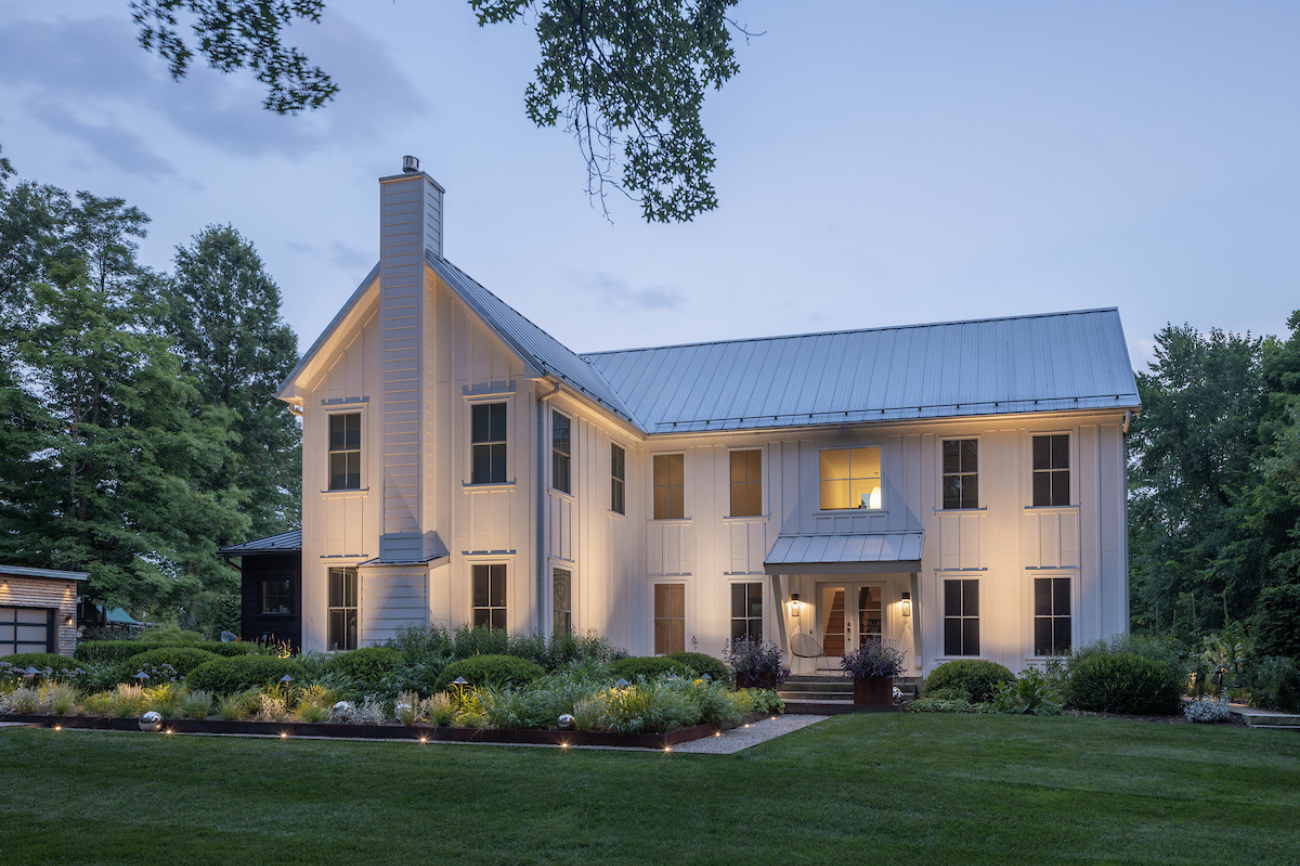
Spring and Summer are the perfect seasons to refresh your exterior with thoughtfully layered outdoor lighting. From welcoming front porch lanterns to landscape lighting that draws out the natural drama of mature trees and garden plantings, the right fixtures enhance curb appeal while improving safety and visibility after dark. This guide covers 21 outdoor lighting ideas designed to elevate your home's exterior with refined materials, architectural scale and energy-efficient solutions. Whether you're planning a full exterior lighting overhaul or adding a few strategic fixtures, explore Lighting Reimagined's outdoor collections or consult our Design Services for a cohesive lighting plan.
Key Takeaways
- Layer three types of light for a complete exterior plan: ambient (entry and porch fixtures), accent (uplights and path lights) and task (step lights and security fixtures)
- Scale matters more than style: a lantern that is too small for your door height or a path light spaced too far apart will undermine even the most curated fixture selection
- Match fixture finishes across zones: front entry, garage facade and pathway lighting should share at least one finish or material to read as a unified plan rather than a collection of individual purchases
- Uplighting a single specimen tree or washing a textured facade with light delivers the highest visual impact per fixture of any outdoor lighting strategy
- Consult a lighting professional before running conduit or hardwiring landscape fixtures, placement decisions are permanent and difficult to correct after installation
Front Entry and Porch Lighting
1. Statement Lanterns flanking the Front Door

2. Pendant Lighting for Covered Porches
Hang a single pendant centered on the porch ceiling at 7 to 8 feet above the floor or use a cluster of two to three on a deeper porch, paired with wall-mounted fixtures on the perimeter. A pendant brings the ceiling down visually, creating an intimate, room-like atmosphere that signals a welcoming and lived-in space rather than a purely functional threshold.
3. Flush Mount or Semi-Flush Ceiling Fixtures for Low-Ceiling Porches

For porches with 8 feet or less of clearance, center a flush or semi-flush fixture overhead and select a diameter proportionate to the ceiling width, typically 12 to 18 inches for a standard single-bay porch. The result is clean, even ambient light that keeps the architectural detail of the ceiling visible rather than drawing attention to the fixture itself.
4. Barn Lights for Farmhouse & Transitional Facades
Mount Gooseneck barn lights above the garage door or flanking the front entry and angle the shade downward to direct light toward the door face or ground plane. The focused, downward throw highlights the texture of the facade while the exposed arm and matte shade add a rugged, architectural presence that complements casual and transitional home styles.
5. Carriage Lights for Traditional & Colonial Homes

Mount carriage-style lanterns at shoulder height flanking the front door, or on brick pillars at the driveway entrance, pairing them with a matching post lantern at the walkway for a consistent traditional aesthetic. The heritage silhouette casts a warm, diffused glow that softens the entry and creates an inviting mood that reads as settled and well-considered from the street.
Pathway and Driveway Lighting

6. Path Lights Along the Front Walkway
Space low-voltage or solar stake lights 6 to 8 feet apart along one or both sides of the front walkway with fixture heads aimed downward, layered with a brighter fixture at the door or gate as the primary source. The result is a guided, lantern-lit approach that clearly defines the arrival sequence and gives the landscaping a manicured, finished look after dark.
7. Bollard Lights for Defined Driveways
Install bollard lights 8 to 10 feet apart along the driveway perimeter, keeping them flush with or just inside the edge of the hardscape so they define the boundary without obstructing the lane. Their upright, architectural silhouette creates a clean, intentional edge between the driveway and the surrounding lawn that a low path light cannot replicate at scale.
8. Solar-Powered Pathway Lighting
Place solar pathway lights in areas with consistent daily sun exposure along garden paths, borders or side-yard walkways where running conduit is impractical, and position them as supplemental accent rather than primary navigation. They add a soft, low-key perimeter glow that is casual and approachable, ideal for side paths where the goal is gentle orientation rather than functional illumination.
9. Step & Riser Lights
Mount recessed or surface-mounted step lights on the vertical riser face of each tread, always in combination with an overhead source rather than as the sole light at a grade change. The visual effect is refined and deliberate: a line of directed light that eliminates the deep shadows responsible for nighttime trip hazards and gives exterior staircases a hospitality-grade finish.
Landscape and Garden Lights

10. Uplighting Trees & Specimen Plants
Position well lights or directional spotlights at the base of the tree, angled upward at 45 to 60 degrees, using two to three fixtures spaced around the base rather than one, with one aimed at the trunk and the others directed toward the canopy to create depth and layering. The canopy becomes a glowing architectural ceiling element after dark and from the street an uplit specimen tree becomes the focal point of the exterior composition rather than a daytime feature that disappears at night.
11. Uplighting Ornamental and Multi-Stem Trees
For smaller ornamental trees like Japanese maples, crape myrtles or clump birch, position a single directional spotlight 2 to 3 feet from the base and aim it upward at a narrow angle to trace the branching structure rather than flooding the entire canopy. The layered, sculptural character of multi-stem trees reads dramatically after dark, creating branching silhouettes that make a front yard feel professionally designed rather than simply lit.
12. Accent Lighting for Garden Beds & Borders
Place low-profile spotlights or ground stakes at the front of the border, angled upward into the plantings at a shallow 30-degree angle, clustering multiple fixtures for a wide bed and keeping the fixture itself below the sightline from the main viewing angle. Seasonal color and texture, including grasses, perennials and flowering shrubs, become visible from inside the home and from the street in a way that daylight often obscures.
13. Retaining Wall Lighting for Front-of-House Hardscape
Integrate linear or recessed fixtures into the cap or face of the retaining wall aimed downward along the wall face, pairing them with path lights along the base so the transition between hardscape and lawn is fully defined at night. The effect adds horizontal dimensionality to the front yard composition, revealing the material and geometry of a hardscape element that would otherwise disappear into shadow after dark.
Architectural and Façade Lighting
14. Wall Wash Lighting for Home Facades
Position uplights 12 to 18 inches from the base of the facade, angled upward at a slight outward angle to graze the surface evenly, using a tighter grazing angle for textured materials like stone, brick or board-and-batten to maximize shadow depth and surface character. The facade reads as an intentional, lit architectural element after dark, making the home appear significantly more substantial from the street.
15. Soffit & Eave Lighting
Recess downlights into soffits at regular intervals along the exterior wall, aimed straight down, spacing them to avoid gaps without over-concentrating, as two to three fixtures per bay is typically sufficient. Soffit lighting delivers controlled, even downlighting that eliminates dark zones along exterior walls so every corner of the facade is readable rather than receding into shadow.
16. Pillar & Column Lighting
Mount fixtures at the base of entryway columns for upward-facing drama or at the top for functional downlighting, and for tall columns combine both approaches to cover both ambient and accent roles. The symmetry draws the eye inward and upward, reinforcing the proportions of the entry architecture and giving the facade a formally composed, hotel-lobby quality from the driveway.
17. Garage Facade Lighting

Install wall sconces or barn lights centered above or flanking the garage door, matching the mounting height of the front entry fixtures so the full facade reads as a unified composition. A properly lit garage facade prevents the largest surface on the front of the home from becoming a dark, disconnected mass that undermines an otherwise well-considered exterior.
Side Yard, Back Entry and Utility Area Lighting
18. Side-of-House Lighting for Safety & Navigation
Mount wall sconces at consistent intervals of 8 to 12 feet along the side of the house at 7 to 8 feet above grade, treating the run as continuous from the front corner to the rear rather than as isolated fixtures with gaps. The result is a fully lit corridor between the front and rear of the property that connects the exterior lighting plan as a complete perimeter rather than a collection of fixtures that ends at the corner.
19. Security & Motion-Activated Lighting
Install motion-activated flood lights at corners and entry points at 10 feet or higher to cast a wide beam across the approach zone, positioning the sensor to cover the most likely approach path and layering them on top of existing ambient lighting. When triggered, they create an immediate, high-contrast visibility shift that deters intrusion while the element of surprise is preserved by the lower-level ambient lighting surrounding them.
Ambient and Decorative Torches
20. String Lights for Porches, Pergolas & Outdoor Structures
Drape festoon or cafe-style string lights across the ceiling of a covered porch or between pergola beams in a parallel or crisscross pattern, keeping suspension points consistent and pairing them with a pendant or wall sconce for task illumination rather than relying on string lights as the sole source. The warm, distributed glow shifts the atmosphere of any covered outdoor space from transitional to social and encourages people to linger at eye level.
21. Solar Lanterns & Decorative Accents
Place freestanding solar lanterns in groupings of two or three at stair landings, along garden borders or flanking a gate, using them as a flexible accent layer on top of a more substantial wired lighting system rather than as a primary source. Grouped rather than scattered, they give the landscape a curated, lived-in character that feels styled: the finishing layer on a well-considered exterior.
Let Us Help You Find Your Perfect Outdoor Lighting Plan
The right outdoor lighting can completely transform how your home looks and feels after dark, but finding the perfect combination of fixtures, placement and scale takes more than a great product list. If you would like expert guidance tailored to your specific home and landscape, Lighting Reimagined’s complimentary Concierge Services connect you with a team of design professionals who can help you build a cohesive exterior lighting plan from the ground up. Whether you’re refreshing a single fixture or reimagining your entire exterior, contact us today to get started.